
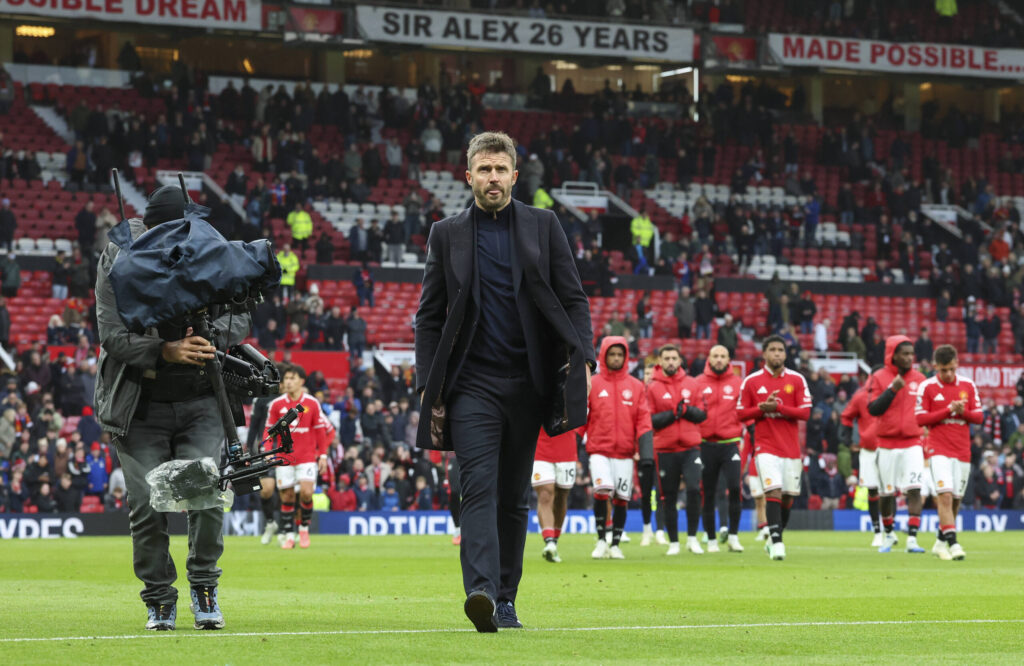
Manchester United leave Michael Carrick in limbo ahead of Chelsea trip
Just when it seemed Manchester United had made up their mind, they appear to have unmade it. Michael Carrick is still in charge. He was on the training pitch at Carrington, preparing his players for the trip to Chelsea, in a job many people assumed he would have left by now.
According to the i Paper, a crisis meeting among senior figures ended without the sacking that had looked almost certain. Given the swirl of rumour around Old Trafford in recent days, that is a significant decision. It is also a revealing one, and not necessarily in a flattering way.
A club one point above the drop
Let us start with the reality, because it still feels surreal to write. Manchester United are one point above the relegation zone. For a club of this size and history, that is a collapse in standards and identity, and it is precisely why so many expected the hierarchy to act quickly after another dismal run.
Instead, they have paused. On Monday the expectation was that Carrick would become the seventh permanent manager to lose his job in 13 years. What followed was drift, noise and then silence. Carrick was reportedly at Carrington as normal on Tuesday, and the club’s messaging stressed that he and the players would have the chance to put things right on the pitch.
There was symbolism in the silence too. On a scheduled day off, Carrick turned up at the training ground to watch the Under-21s play a friendly against Hull City. It was the behaviour of a man still fully committed to the job, or at least determined not to act like someone who had already been cut loose.
It is worth noting how quickly the mood shifted. Only days earlier, a heavy home defeat to Bournemouth and a public disagreement with captain Bruno Fernandes over tactics had left Carrick looking isolated. The idea that he would survive the week seemed far-fetched to most observers, which is what makes this U-turn so striking.
Why United have hesitated
The reasons for the reprieve appear to come down to two things: money and uncertainty. Omar Berrada and Jason Wilcox are said to believe there is no point making a change unless the right replacement is lined up, committed and clearly an upgrade.
On one level, we understand that. United have wasted extraordinary sums over the years on compensation and severance for departing managers. Another sacking would mean another bill and another awkward explanation of why the last plan failed.
There is also a feeling inside the club that the endless cycle of dismissals has to end. That is fair. Changing the man in the dugout over and over has not fixed a broken structure. But breaking the cycle only works if the current manager is genuinely the answer. Keeping a coach simply because the club is tired of firing coaches is not a strategy. It is exhaustion.
And caution carries its own risk. Results do not wait for boardroom certainty. Chelsea away is a brutal fixture for a fragile team, and if United lose again, the executives who chose to wait will share the blame.
No clear successor either
The list of possible replacements only adds to the sense of indecision. Eddie Howe has admirers, particularly because of his Premier League experience, but the finances around any move are said to be complicated. Fabian Hürzeler and Unai Emery look expensive and difficult to prise away. Julian Nagelsmann has backers too, though some within the club are wary of his lack of experience in English football.
That absence of consensus is telling. Successful clubs can be ruthless because they know exactly what they want next. United, on this evidence, are still arguing over the blueprint while the house is on fire.
Then there are the supporters. The applause Carrick received from fans at the weekend has been noticed internally, and it should not be dismissed. Supporters recognise effort, dignity and honesty, especially in difficult times. Many sense he is not the root cause of the chaos, but someone working inside a dysfunctional system that has swallowed up several managers before him.
The danger is that this reprieve satisfies nobody. Those who want Carrick gone will see it as weakness, and those who want him to succeed will see a manager working without genuine backing. Neither outcome helps a squad that badly needs clarity and stability.
Our take
Honestly, we find this remarkable. Everything pointed one way, and then United somehow made the situation even messier by doing nothing at all. Carrick remains in post, the season is heading towards embarrassment, and the club looks stuck somewhere between panic and paralysis.
We have real sympathy for Carrick. He conducts himself with decency and composure, and the deeper problems at Old Trafford have outlasted plenty of managers before him. But sympathy does not change the league table. Sitting one point above the bottom three is unacceptable for Manchester United, and it should be setting off alarms in every office at the club.
What frustrates us most is the lack of clear purpose. If the hierarchy believe Carrick can turn it around, they should back him properly and say so with conviction. If they do not, they should act. Leaving him in limbo helps no one, least of all the players, who now travel to Chelsea with uncertainty hanging over them.
There is still a chance of a response. Football has a habit of producing a twist just when things look bleakest. But that requires courage, discipline and unity, qualities this team has too often lacked. The Chelsea game now feels enormous. If the players respond, this reprieve could be remembered as a show of nerve. If they fold again, it will look like yet another example of a club frozen by indecision when it needed to be decisive.